
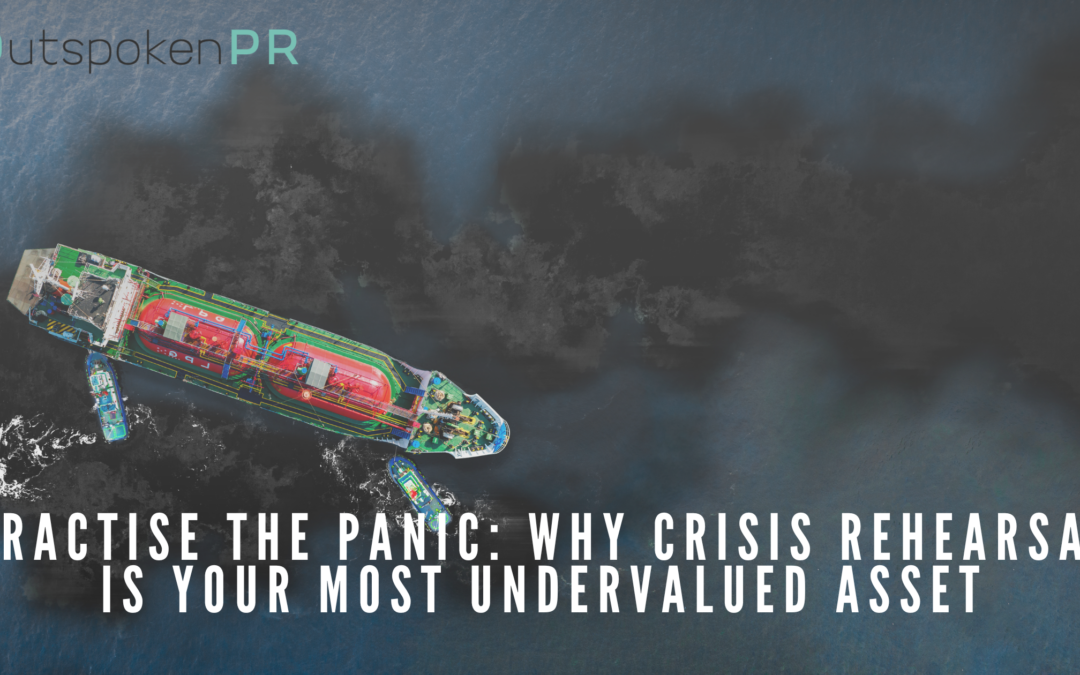
Practise the panic:
why crisis rehearsal is your most undervalued asset
Nobody wants to plan for disaster. Hours spent focusing on that moment when an employee screenshots an internal email and posts it publicly, or the day a senior executive’s behaviour makes the headlines hard to justify. And yet, for communications professionals and business leaders, being prepared for these moments is not a nice-to-have, but an essential piece of armour in the battle to protect company reputations.
What a real crisis looks like
Consider a few scenarios that land on desks every year:
An internal email thread gets forwarded outside the organisation, revealing that a senior executive’s personal life conflicts sharply with the values the organisation has been publicly championing.
By the time it’s been shared on social media, the original context is gone. What remains is a screenshot, a narrative, and a growing audience. The board is divided, HR is nervous and speculation grows by the minute.
A ransomware attack takes down core systems overnight. IT still doesn’t know the full extent of the breach. By 9am, customers are posting about failed transactions and a tech journalist has already sent a DM asking you for comment. They are going live with their news in 2 hours whether you are included in it or not.
In each of these cases, the organisation that fares best isn’t necessarily the one with the most sophisticated crisis plan in a drawer somewhere. It’s the one whose people know their role, can draft a holding statement under pressure, and understand that the first sixty minutes can define their company’s reputation for years.
The difference between organisations that emerge from a crisis with their reputation intact and those that don’t lies in how well rehearsed internal teams are in facing a crisis. At OutspokenPR we’ve distilled four “Ts” of crisis communications that can help you reach that level of preparedness.
The four Ts of crisis communication
Transparency: Be transparent about what you do and what you don’t know at every step of the way. Legal most likely will advise you to say as little as possible while the picture is still forming, but the reality is that silence does not buy time: it creates a vacuum. In that vacuum someone else’s narrative will emerge.
The public, regulators, and journalists are also surprisingly forgiving of organisations that admit uncertainty early. The reverse is true for organisations that seem to have purposefully hidden what they knew. Think of the way that J&J was able to bounce back from the 1980s Tylenol poisoning by being transparent on what they knew and contrast with the reputational damage to Volkswagen caused by the massive coverup around fraudulent diesel engine emission testing.
Timeliness: In a world of social media and 24-hour news, every ten minutes without a response is ten minutes of unchecked speculation. A fast, honest holding statement is almost always better than a polished statement that arrives two hours too late. If you have internal systems in place for a potential crisis (shorter approval cycles, rapid source directories etc.) then you will be able to achieve speed without rushing.
Trust: Trust, they say, is earned. Trustworthy businesses communicate with transparency and speed and do so because they are committed to their stakeholders and clients for the long-term. Plain language, reliable follow ups and regular updates are the cornerstone of creating and maintaining trust.
Tailoring: Different audiences are worried about different things, and they need reassurance delivered differently. A union workforce wants to hear from internal communications before they see it on the news. An institutional investor wants calm, factual context. A community group affected by an environmental incident wants acknowledgement and plain language. The trap most organisations fall into is writing a single statement and broadcasting it everywhere. That’s not communications strategy; it’s a broadcast and fails to take into account your audience entirely.
The holding statement
A good holding statement should acknowledge the issue without trivializing, recognising the human impact without admitting liability. Speculation feeds the information vacuum, blaming a third party will drag you both through the mud and sanitized corporate speak will push the public even further away.
A powerful statement should name at least one reparative or investigative action that is already underway. Vague statements such as “we are actively monitoring the situation” are not communications: why should anyone feel relaxed that you (who created the problem in the first place!) are standing by and watching the disaster unfold?
Organisations that have already internalised these points and practiced with them will s respond faster, communicate more clearly, and make fewer escalating errors when the real thing comes along. The discomfort of making decisions under time pressure with incomplete information is real, but learning how to manage it translates directly to calmer, sharper performance on the day. The best crisis response is the one you already practised.
team@outspokenpr.com